Good Clinical Practice – ICH E6 (R3): Step 2 Changes overview
Background
• This document has been signed off as a Step 2 document (19 May 2023) to be issued by the ICH Regulatory Members for public consultation. The link to the text of the E6 (R3) draft STEP 2 (19 May 2023).
• This document was developed based on a Concept Paper (approved 18 November 2019) and a Business Plan (approved 18 November 2019).
• Anticipating finalisation as a Step 4 document to be implemented in the local regional regulatory system: August/September 2024.
ICH-E6: An Important Global Standard for Clinical Trial Conduct
• E6: Good Clinical Practice (GCP) – finalised in 1996 ‒ Described the responsibilities and expectations of stakeholders in the conduct of clinical trials; ‒ Covered aspects of monitoring, reporting, and archiving of clinical trials; and ‒ Included sections for essential documents and investigator brochures.
• E6 (R2) – finalised in 2016 ‒ Included integrated addendum to encourage implementation of improved and more efficient approaches to GCP, while continuing to ensure human subject protections; and ‒ Updated standards for electronic records.
Background to E6(R3) Renovation
Recently, the Clinical Trials Transformation Initiative (CTTI) conducted several efforts to help inform the International Council for Harmonisation of Technical Requirements for Pharmaceuticals for Human Use (ICH) as it revises ICH E6 Good Clinical Practice (GCP):
- Through a global, multi-stakeholder survey with 327 research professionals from 154 countries, in-depth interviews, and a public open comment period, CTTI issued a report outlining the areas requiring the most focus pertaining to sponsors, essential documents, and investigators.
- CTTI co-hosted a public event with the FDA to help the ICH in its efforts to improve various topics within GCP.
- CTTI also convened two public web conferences hosted by the ICH that provided an update on the progress to revise this important and impactful guideline.
Gap Analysis
Purpose:
To help inform where modifications were needed.
Stakeholder Comment Analysis:
- Academic Responses
- Open letter to EMA & ICH
- Published articles
- Responses to Clinical Trials Transformation Initiative (CTTI) survey, and interviews on “Informing the Renovations to the ICH E6” Project
- Inputs from regional public engagement ICH Guideline Analysis
- Relevant ICH guidelines
Initial Takeaways from Feedback and Comments on ICH E6(R2)
- Although E6 is intended for clinical trials to support registration/approval of medicinal products, it is also widely applied to other types of clinical trials of medicinal products.
- Concerns that the current guidance has a “one-size-fits-all” approach to clinical trials.
- Concerns about ability of clinical trials to meet all GCP requirements in different situations (e.g., during public health emergencies).
- Concerns that GCP requirements were being applied where it is not applicable.
Highlighting the Importance of Clinical Trials
1. Clinical trials are a fundamental part of clinical research.
-
Well designed and conducted clinical trials yield reliable results and help ensure participant safety.
-
Poorly designed clinical trials waste resources and have the potential to put participant's safety at risk.
2. The principles of GCP are designed to:
- be flexible and applicable to a broad range of clinical trials;
- encourage thoughtful consideration and planning; and
- be considerate of the factors relevant to ensuring trial quality is needed for each clinical trial.
What is unique about E6(R3) development process
- Engagement with academic stakeholders in a series of joint meetings with the Expert Working Group.
- New approaches to enhance transparency (published draft principles in April 2021 and held public web conferences (2 days) in May 2021).
- Extensive training materials are planned to be developed (with usecases) that clarify or provide supplementary explanation to the application of GCP guidelines.
What is new about E6(R3) structure and content?
1. New structure to provide clarity and better readability:
- Principles to remain relevant as technology, methods and trial design evolve.
- Annexes and appendices (strategy intended to enable easier and faster updates in the future).
- Provide additional clarity on the scope.
2. Language to facilitate innovations in clinical trial design, technology and operational approaches:
- Facilitate innovative clinical trial designs, for example, clinical trials utilising Decentralised Clinical Trial (DCT) elements and pragmatic elements, reflecting trials that closely resemble routine clinical practice.
- Facilitate the use of Digital Health Technologies (DHTs), healthcare infrastructure, and other tools to facilitate enrollment and retention, capture data, monitor, and to analyse results.
3. Set a foundation for practical/feasible expectations around the responsibilities of sponsor and investigator in a digital ecosystem.
4. Encourage fit-for-purpose approaches:
- Proportionality and risk-based approaches with a focus on the clinical trial's critical-to-quality factors whose integrity is fundamental to safety of participants and the reliability of trial results;
- Thoughtfulness in the design and conduct.
5. Incorporate learning from innovative clinical trial designs and lessons from public health emergencies/pandemics.
6. Encourage transparency by clinical trial registration and result reporting.
7. Provide additional language to enhance the informed consent process.
OVERVIEW OF ICH E6 (R3)

Revised Structure
E6 (R3) Draft Guideline: E6 (R3) draft guideline subject to public consultation consists of parts I, II, III ( composed of 4 sections), glossary, and appendices.
|
Open for public consultation now
|
|
Clear Scope, Proportionality & Focus on Quality
- This guideline applies to interventional clinical trials of investigational products that are intended to be submitted to regulatory authorities. This guideline may also be applicable to other interventional clinical trials of investigational products that are not intended to support marketing authorisation applications in accordance with local requirements.
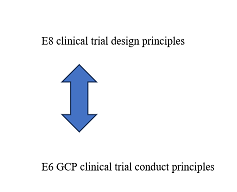
- This guideline builds on key concepts outlined in ICH E8 (R1) General Considerations for Clinical Studies. This includes fostering a quality culture and proactively designing quality into clinical trials and drug development planning, identifying factors critical to trial quality, and engaging stakeholders, as appropriate, using a proportionate risk-based approach.
- Clinical trials vary widely in scale, complexity, and cost. Careful evaluation of the scientific objectives involved in each trial and risks associated with the priorities will help ensure efficiency by focusing on activities critical to achieving the trial objectives.
Innovation, Efficiency & Engagement
1. Encouraging the exploration of technology:
- The principles are intended to support efficient approaches to trial design and conduct. For example, innovative digital health technologies, such as wearables and sensors may expand the possible approaches to trial conduct.
- Such technologies can be incorporated into existing healthcare infrastructures and enable the use of a variety of relevant data sources in clinical trials.
- The use of technology in the conduct of clinical trials should be adapted to fit the participant characteristics and the particular trial design.
2. Encouraging engagement and inclusivity:
- The use of innovative clinical trial designs and technologies may help include diverse patient populations, as appropriate, and enable wider participation.
- The design of the trial, to ensure appropriate quality and meaningful trial outcomes, may be supported by the perspectives of stakeholders; for example, patients and/or health care providers. Their input can increase the likelihood of meaningful trial outcomes, which are relevant to both trial participants and future patients. This input will also guide decisions on the feasibility of data collection and assure that participation in the trial does not become unduly burdensome for those involved.
Focus on appropriate quality (QbD and proportionate)
- Quality by design should be implemented to identify the factors (i.e., data and processes) that are critical to ensuring trial quality and the risks that threaten the integrity of those factors and ultimately the reliability of the trial results.
- Clinical trial processes and risk mitigation strategies implemented to support the conduct of the trial should be proportionate to the importance of the data being collected and the risks to trial participant safety and data reliability. Trial designs should be operationally feasible and avoid unnecessary complexities.
Substantial Changes |
| • Principles of GCP |
| • Annex 1
|
| • Glossary |
| • Appendix C
|
Other Changes |
| • Annex 1
|
| • Appendices A & B
|
ICH E6 (R3) PRINCIPLES
| ICH E6 (R3) PRINCIPLE | TOPIC | ICH E6 (R2) REF |
| 1 | Ethical Principles | 2.1, 2.2, 2.3, 2.7, 2.11 |
| 2 | Informed Consent | 2.9 |
| 3 | IRB/IEC Review | 2.6 |
| 4 | Science | 2.4, 2.5 |
| 5 | Qualified Individuals | 2.8 |
| 6 | Quality | 2.13 |
| 7 | Risk Proportionality | N/A |
| 8 | Protocol | 2.5 |
| 9 | Reliable Results | 2.10 |
| 10 | Roles and Responsibilities | N/A |
| 11 | Investigational Products | 2.12 |
ICH E6 R(3) Principles - New
Risk Proportionality:
- Focus on participant’s safety and reliability of results.
- Risks beyond those associated with standard medical care.
Roles and Responsibilities:
- Clarification of transfer of activities by the Sponsor and delegation by the Investigator.
- Maintenance of appropriate oversight.
ICH E6 R(3) Principles - Revised
Ethical Principles:
•Making sure not to unnecessarily exclude particular participant populations.
Informed Consent:
•Taking into consideration relevant aspects of the trial.
IRB/IEC Review:
•Periodic review according to applicable regulatory requirements.
Science:
•Periodic review of scientific knowledge and approaches to determine whether modifications to the trial are needed.
Qualified Individuals:
•Individuals with different expertise and training may be needed across all phases of a clinical trial.
Quality:
•The quality and amount of the information generated should support good decision making.
Protocol:
•A well-designed trial protocol is fundamental to the protection of participants and for the generation of reliable results.
•The protocol and other documents (e.g., statistical analysis plan, data management plan) for trial execution should be clear, concise and operationally feasible.
Reliable Results:
•Trial processes should support the key trial objectives.
•Clinical trials should incorporate efficient and well-controlled processes for managing records through appropriate management of data integrity.
•The transparency of clinical trials with registration on publicly accessible databases and the public posting of clinical trial results.
Investigational Product:
•Investigational products should be carefully managed to align with treatment assignment and maintain blinding, where applicable.
•The investigational product provided to the trial participant should retain its quality.
ICH E6 (R3) ANNEX 1 IRB/IEC
| ICH E6 (R3) Section | ICH E6 (R2) Ref. |
| 1.1 – Responsibilities | 3.1 • Section 3.1.6 on nontherapeutic trials removed |
| 1.2 – Composition, Function and Operations | 3.2 |
| 1.3 – Procedures | 3.3 |
| 1.4 – Records | 3.4 |
| 1.5 – Submission and Communication • In R3, added global language about reporting to IRB/IEC and regulatory authorities | N/A |
IRB/IEC
- Included global language about reporting to IRB/IEC and regulatory authorities.
- Updated to reflect digitisation and variable approaches to obtaining consent.
- Clarified the potential for participants to be compensated for costs incurred to participate in the trial.
ICH E6 (R3) ANNEX 1 - INVESTIGATOR
| ICH E6 (R3) Section | ICH E6 (R2) Ref. |
| 2.1 – Qualifications and Training | 4.1 |
| 2.2 – Resources | 4.2 |
| 2.3 – Responsibilities | 4.1, 4.2 |
| 2.4 – Communication with IRB/IEC | 4.4, 4.10 |
| 2.5 – Compliance with Protocol | 4.1 |
| 2.6 – Premature Termination or Suspension of a Trial | 4.12 |
| 2.7 – Participant Medical Care and Safety Reporting | 4.3, 4.11 |
| 2.8 – Informed Consent to Trial Participants | 4.8 |
| 2.9 – End of participation in a clinical trial | 4.3 |
| 2.10 – Investigational Product Management | 4.6 |
| 2.11 – Randomisation Procedures and Unblinding | 4.7 |
| 2.12 – Records | 4.9 |
| 2.13 – Clinical Trial / Study Reports | 4.13 |
Investigator - Informed Consent Changes
• …..Varied approaches to the provision of information and the discussion about the trial can be used. This can include, for example, providing text in different formats, images and videos and using telephone or video conferencing with investigator site staff. Informed consent is documented by means of a written or electronic, signed and dated informed consent form. Obtaining consent remotely may be considered when appropriate.
• The information should be as clear and concise as possible, use simple language and avoid unnecessary volume and complexity.
• In exceptional circumstances (e.g., public health emergencies), when the usual methods to obtain and document informed consent are not possible, the use of alternative measures and technologies in accordance with local IRBs/IECs and applicable regulatory requirements should be considered.
• Where a minor is to be included as a participant, age-appropriate assent information should be provided and discussed with the minor as part of the consent process ….. A process for re-consent should be considered if during the trial, the minor reaches the age of legal consent, in accordance with applicable regulatory requirements.
Investigator (2)
• Clarified evidence for qualifications:
o Allow flexibility about documentation, frequency of updates
• Clarified overall training requirements for trial staff:
o Trial-related training to persons assisting in the clinical trial should correspond to what is necessary to enable them to fulfil their delegated trial-related activities that go beyond their usual training and experience.
• Clarified expectations regarding the use of computerised systems at the investigator site.
Investigator (3)
• Clarified the expectations between the sponsor and investigator regarding service providers and the investigator regarding transfer/delegation of activities to service providers.
• Clarified expectations regarding identification and maintenance of source records and timely data review.
• Clarified requirements for delegation documentation, e.g., trial-specific delegation documentation may not be required in situations where the clinical trial activities are performed in accordance with routine clinical care.
ICH E6 (R3) ANNEX 1 - SPONSOR
| ICH E6 (R3) Section | ICH E6 (R2) Ref. |
| 3.1 – Trial Design | 5.0, 5.4 |
| 3.2 – Resources | NA |
| 3.3 – Allocation of activities | 5.7 |
| 3.4 – Qualification and Training | 5.3, 5.4 |
| 3.5 – Financing | 5.9 |
| 3.6 – Agreements | 5.1, 5.2, 5.6, 5.9, 5.23 |
| 3.7 – Investigator Selection | 5.6 |
| 3.8 – Communication with IRB/IEC and Regulatory Authority(ies) | 5.10, 5.11 |
| 3.9 – Sponsor Oversight | NA |
| 3.10 – Quality Management | 5.0 |
| 3.11 – Quality Assurance and Quality Control | 5.1, 5.18, 5.19 |
| 3.12 – Non-compliance | 5.20 |
| 3.13 – Safety Assessment and Reporting | 5.16, 5.17 |
| 3.14 – Insurance/Indemnification/Compensation to participants and investigators | 5.8 |
| 3.15 – Investigational Product(s) | 5.12, 5.13, 5.14 |
| 3.16 – Data and Records | 5.5, 5.15 |
| 3.17 – Reports | 5.21, 5.22 |
Sponsor
Monitoring:
- Clarified that monitoring is one of the principal QC activities.
- Clarified expectations for centralised monitoring and visits to investigator sites (performed on-site or remotely).
- The monitoring strategy should consider the trial purpose, design, blinding, safety profile, endpoints in line with the risk proportionate approach for that investigational product in that participant population.
Investigational Product:
- Clarified that for product that has a marketing authorisation, alternative approaches may be considered e.g.,:
- The basic product information may be used in place of the investigator’s brochure.
- Alternative approach to drug accountability records may be applicable, in accordance with local regulatory requirements.
Quality Management:
• Further clarified the requirements for the assessment and management of critical to quality factors impacting participant safety or result reliability.
• Encouraged proportionality and clarified acceptable ranges beyond which deviations could represent systemic issues.
Computerised Systems and Data Management:
• Clarified the importance of certain processes, such as blinding, and provided reasonable perspective on when unblinding may occur.
• Clarified that the requirements for computerised systems should be appropriate and risk-based.
• These requirements should be proportionate to the importance of the computerised system and the data or activities they are expected to process.
Sponsor Oversight:
• Included oversight of other sites, e.g., central scanning facilities, as part of overall QC strategy.
ICH E6 (R3) ANNEX 1 DATA GOVERNANCE
| ICH E6 (R3) Section | ICH E6 (R2) Ref. |
| 4.1 – Safeguard Blinding in Data Governance | NA – Major Revamp |
| 4.2 – Data Life Cycle Elements | |
| 4.3 – Computerised Systems | |
| 4.4 – Security of Computerised Systems | |
| 4.5 – Validation of Computerised Systems | |
| 4.6 – System Failure | |
| 4.7 – Technical Support | |
| 4.8 – User Management |
Data Governance
- Sponsor should apply quality control to the relevant stages of data handling to ensure data are of sufficient quality to generate reliable results.
- Manage computerised system to ensure they are fit for purpose and in a manner that is proportional for their importance to safety and result reliability.
- Comprehensive approach to data systems (e.g., IT security, data protection, data validation, metadata, data acquisition tools).
o The quality and amount of the information generated in a clinical trial should be sufficient to address trial objectives, provide confidence in the trial’s results, and support good decision making.
o The systems and processes that help ensure this quality should be designed and implemented in a way that is proportionate to the risks to participants and the reliability of trial results. - Clarified the meaning of metadata.
o In the context of this guideline, relevant metadata needed to reconstruct the trial conduct is the focus.
ICH E6 (R3) ANNEX 1 - GLOSSARY
| New Glossary Terms | Revised Glossary Terms |
| Assent | Essential Records |
| Computerised Systems Validation | IRB/IEC |
| Data Acquisition Tool | Investigator |
| Metadata | Investigator Site |
| Reference Safety Information | Source Records |
| Service Provider | Sponsor |
| Signature | Trial Participant |
| Adverse Events and Adverse Reaction-related definitions | |
| And Others… |
Updating The Glossary (examples)
- Adding terms that support advances in the clinical trial ecosystem.
o Data Acquisition Tool (DAT):
- A paper or electronic tool designed to collect data and associated metadata from a data originator in a clinical trial according to the protocol and to report the data to the sponsor.
o Service provider:
- A person or organisation (commercial, academic or other) providing a service used during the conduct of a clinical trial to either the sponsor or the investigator to fulfil one or more of their trial-related activities.
- Providing more clarity on Adverse Events and Adverse Reactions.
- Updated some definitions (e.g., investigator site) to adapt for clinical trial operations in decentralised settings.
- Adapted definitions as needed to implement the media-neutral approach consistently.
- Participants to replace subjects.
- Removed confusing language and terms (e.g., non-therapeutic trials).
ICH E6 (R3) APPENDIX A - INVESTIGATOR’S BROCHURE
| ICH E6 (R3) Section | ICH E6 (R2) Ref. |
| A.1 – Introduction | 7.1 |
| A.2 – General Considerations | 7.2 |
| A.3 – Contents of the Investigator’s Brochure • A.3.6 (b) – In R3, added frequency and nature of AEs should be included to determine expectedness of Serious Adverse Reactions. | 7.3 |
Investigator’s Brochure
- Added that a list of expected adverse reactions identified as the reference safety information, including information on their frequency and nature, should be included.
- Reorganized the order of language for clarification.
- Examples of title page and table of contents removed as same information can be read in the text of the guideline.
ICH E6 (R3) APPENDIX B - CLINICAL TRIAL PROTOCOL AND PROTOCOL AMENDMENTS
| ICH E6 (R3) Section | ICH E6 (R2) Ref. |
| B.1 – General Information | 6.1 |
| B.2 – Background Information | 6.2 |
| B.3 – Trial Objectives and Purpose | 6.3 |
| B.4 – Trial Design | 6.4 |
| B.5 – Selection of Participants | 6.5 |
| B.6 – Withdrawal of consent / discontinuation of participation | 6.5 |
| B.7 – Treatment and Interventions for Participants | 6.6 |
| B.8 – Assessment of Efficacy | 6.7 |
| B.9 – Assessment of Safety | 6.8 |
| B.10 – Statistical considerations | 6.9 |
| B.11 – Direct Access to Source Records | 6.10 |
| B.12 – Quality Control and Quality Assurance | 6.11 |
| B.13 – Ethics | 6.12 |
| B.14 – Data Handling and Record Keeping | 6.4, 6.13 |
| B.15 – Financing and Insurance | 6.14 |
| B.16 – Publication Policy | 6.15 |
| NB: Section 6.16 on supplements relating to Final CSR removed. | |
Protocol
- Highlights the importance of the protocol, such as:
- Building adaptability into the protocol, for example, by including acceptable ranges for specific protocol provisions, can reduce the number of deviations or in some instances the requirement for a protocol amendment.
- Encourages simplicity and clarity:
- Clinical trials should be described in a clear, concise and operationally feasible protocol. The protocol should be designed in such a way as to minimise unnecessary complexity and to mitigate or eliminate important risks to the rights, safety, and wellbeing of trial participants and reliability of data.
- Addresses the implication for withdrawal of consent or discontinuation by the investigator.
- Broadened the statistical section to include statistical inference methodologies (e.g., Bayesian design and estimands).
ICH E6 (R3) APPENDIX C - ESSENTIAL RECORDS FOR THE CONDUCT OF A CLINICAL TRIAL
| ICH E6 (R3) Section | ICH E6 (R2) Ref. |
| C.1 – Introduction | 8.1 |
| C.2 – Management of Essential Records | NA – Major Revamp |
| C.3 – Essentiality of Trial Records |
Essential Records
- Provided guidance on what makes a record essential.
- Many records are generated before and during the conduct of a clinical trial. The nature and extent of those records generated and maintained are dependent upon the trial design, its conduct, application of proportional approaches and the importance and relevance of that record to the trial.
- Many records are generated before and during the conduct of a clinical trial. The nature and extent of those records generated and maintained are dependent upon the trial design, its conduct, application of proportional approaches and the importance and relevance of that record to the trial.
- Provided clarity on the content and maintenance of essential records.
- Developed two tables, which are a table of essential records for all trials and a table of potential essential records.
In Summary
- Novel approaches to clinical trial design and conduct have the potential to streamline drug development and increase the convenience of clinical trials for participants.
- The intent of the revised guideline is to facilitate innovations in clinical trial design and conduct, while at the same time provide guidance to help ensure participant safety and that the clinical trial produces reliable results.
- We welcome your comments on this draft guideline to highlight any considerations we have missed or clarify where the text is ambiguous.
Author: International Council for Harmonisation of Technical Requirements for Pharmaceuticals for Human Use. 22 May 2023.
REFERENCES
- ICH E6 (R3) – Draft Principles and Annex 1
- ICH E6 (R2)
- ICH E6 (R3) Public Web Conference – May 2021
Contact: For any questions please contact the ICH Secretariat: admin@ich.org
Clinical Research News
Prossimi studi clinici
-
Magnus MedicalCongressionally Directed Medical Research ProgramsReclutamento
-
Nicholas ButowskiSiren BiotechnologyNon ancora reclutamentoGlioma | Neoplasia cerebrale | Gliomi ricorrenti di alto gradoStati Uniti
-
State University of New York at BuffaloNon ancora reclutamentoCoinvolgimento del pazienteStati Uniti
-
Poitiers University HospitalNon ancora reclutamento
-
Assistance Publique - Hôpitaux de ParisNon ancora reclutamentoAnemia falciforme | Crisi vaso-occlusiva
-
University of California, IrvineReclutamentoCancro al cervello | Cancro al SNC | Cancro del sistema nervoso | Metastasi del Cancro al CervelloStati Uniti
-
Qualia Life SciencesReclutamento
-
Guangdong Raynovent Biotech Co., LtdNon ancora reclutamento
-
The Hong Kong Polytechnic UniversityWu Jieh Yee Charitable FoundationReclutamentoAdulti | Assistenza digitale per ipovedenti | Deficit VisiviHong Kong
-
Shanghai General Hospital, Shanghai Jiao Tong University...Non ancora reclutamentoAdenocarcinoma duttale pancreatico (PDAC)
-
Sun Yat-sen UniversityNon ancora reclutamentoSmettere di fumare | Agente AI | Early-Stage Cancer
-
Affiliated Hospital of Nantong UniversityNon ancora reclutamento
Clinical Research Jobs
-
United States - Ohio - Cincinnati
-
China - Chengdu
-
Poland - Warsaw
-
India - Kochi
-
Romania - Bucharest
-
Philippines - Manila
-
India - Bengaluru
-
United States - North Carolina - Morrisville
-
China